
Saturday, January 9, 2010

Saturday, January 2, 2010

Tuesday, November 24, 2009
Sehwan Sharif


Sehwan (Urdu: سیہون) (aka: Sehwan Sharif) is located in Sindh province of Pakistan. Sehwan town is of unimpeachable antiquity, Sehwan, some eighty miles north-west of Hyderabad lay on the opposite bank of the Indus. It is possible that the name Sehwan originates from "Siwistan" or "Seevistan", the kingdom of Raja Dahir which even extended to Punjab under the name "Shivi".[1] It was significant enough during the 8th century to be conquered by Muhammad bin Qasim in 711 CE, and two centuries later by Mahmud of Ghazni. An abortive attempt was made by the Mughal emperor Humayun to capture it on his way to Umarkot but it finally fell to his son Akbar. Apart from the remnants of the ruins scattered about its environs, the most famous monument in Sehwan remains the shrine of Hazrat Lal Shahbaz Qalandar.
The city is known for its Muslim patron saint Hazrat Lal Shahbaz Qalandar who lived here in 13th century CE. The mausoleum of Hazrat Shahbaz Qalandar attracts hundred of thousands of faithful every year.

Taluka sehwan is located in Jamshoro District of Sindh Pakistan at the right bank of river indus. Sehwan sharif is famous in Pakistan and world level for sufiism due to the great saint Hazrat (Usman Marwandi) qalandar lal shahbaz. another famous place is the inverted city besides the Dargah of Hazrat Lal Shahbaz Qalander, may be the Debal Bandar of Raja Dahar. The Manchhar lake the biggest lake of Asia is in a little distance from Sehwan Sharif.
Sehwan Sharif is the eternal resting place of Hazrat Syed Usman Marwandi (Sindhi) also known as Lal Shahbaz Qalandar. He was born in 538 A.H, (1143 AD) in Marwand Iran.
Reference book, Qalandar Nama Sindhi,
His ancestors migrated from Iraq and settled down in Mashud Iran, from where they again migrated to Marwand. During the Medieval period, Mashud and other cities of that region were renowned centers of learning and civilization. His father, Syed Ibrahim Kabiruddin was a virtuous and pious dervish, and his mother was a high-ranking princess.
Syed Ibrahim Kabiruddin never thought of getting married because of prayers. With reference of book ‘lub tarik sindh’ one night Holy soul of Lal Qalandar turns up in the dream of his father “Syed Ibrahim Kabiruddin” asking him to get married saying "Get married as I have to be born by you". The birth date, age and last days of your life are mentioned in (Qalandar Nama Sindhi). The Birth name of this angelic nature baby was Syed Shah Hussain, but according to Tazkara-e-Shahbaz the name USMAN was given to hsi father and grandfather as this name was given by Hazrat Imam Hussain to his father and grandfather in their dream.
In Accordance with Alshahbaz book at the time of birth his appearance was rosy which is why his father used to call him LAL red. He liked red color since childhood and always used to wear red attire, holding a red flag and even he had red eyes. All those things gave him the title of "Lal" which literally means "red". The name Shahbaz was given to him by his spiritual master Hazrat Baba Ibrahim. He was also called saif-ul-lisan because Allah used to fulfill his every word as a token of extreme devotion to Allah. He is also known by the names Qutub-Uddin and Shams-Uddin.
Even as a young boy, Usman Marwandi showed strong religious leanings and had learnt the Holy Quran by heart just at age of seven, and at twenty embraced the Qalandar order of Sufism. The Qalandari and Qadri orders are alike spiritually according to ILM Ali Qalandar. Qalandar is a type of dervish who is generally dressed in beggars’ clothes, likes poverty and austerity and has no permanent dwelling.
Lal Shahbaz Qalandar wandered throughout Middle East and came to Sind from Baghdad via Dasht-i-Makran.Valley of panjghoor (Baluchistan) near Rakshanh stream where he did his spiritual exercise, this place is remembered by his name as DASHT-E-SHAHBAZ.
In 1263, he arrived in Lahore and then visited the shrine of Data Gunj Baksh and stayed there for forty days, and visited the shrines of Hazrat sheikh Hussain Zanjani, Hazrat Syed Ishaq Zanjani and Syed Yaqoob Zanjani. Then he proceededt to Sialkot and visit Hazrat Imam Ali La Haq. Then hejourneyed to Multan and meet Hazrat Ghous Bahauddin Zikria, and his great son Sheikh sadr-uddin Arif, which at that time was at the height of glory and splendor.
According to famous book “Kashf-ul-lugat” Qalandar means "who is gone astray in the love of GOD".
As Iqbal put it "Thousand of sorrows but heart is the language of GOD. It has always been the way of Qalandari"
The people of Multan besought him to stay but he continued his journey southward and eventually settled down in Sehwan, then a famous center of learning and popular place of worship for Hindus, in the southern part of Sindh, where he lived in the trunk of a tree on the outskirts of the town. He stayed at Sehwan for six years and during this period he disseminated the light of Islam, providing guidance to thousands of people.
As Qalandar put it "Nameless and tongue less still I am the mystic of GOD. Nameless and mark less but still I’m the devote of GOD"
Sehwan is probably the town with the oldest continuous existence in Sind and in those days was the capital of a Buddhist ruler who was brother of Chandragupta II, the third of the Guptan dynasty in the 4th century AD. From the time of Arab invasion in 712, Sehwan was very important in the history of Sind since it commanded the route from the Upper to the Lower Indus, through which all invaders from either north or south had to pass. The possession of the fort was essential to the success of every campaign.
Lal Shahbaz Qalandar is an overwhelmingly popular patron saint who is cherished and adored alike by Hindus and Muslims of Sind. He was a great missionary, mystic, scholar, philosopher and poet. Several books in Persian and Arabic on philosophy and poetry are attributed to him.
He was ‘Lal’ (red) because of his red attire, ‘Shahbaz’ due to his noble and divine spirit that soared like a falcon higher and higher in the boundless heavens and ‘Qalandar’ since he belonged to Qalandria order of Sufism and was saintly, exalted and intoxicated with love for eternal being of God.
As Qalandar put it "Entrance of Heaven is towards me but valueless without you. Houri and nymph are towards me but nothing without you.I went to the heavens and lay down on the seat of GOD. Swear to GOD worthless without you"
The legend goes that the incumbent fakirs in Sewhan sent him a bowl of milk filled to the brim indicating that there was no room for anything more. But surprisingly, he returned the bowl with a beautiful flower floating on the top.
As Qalandar put it "I always do the devotional dance on fire in the love my friend. At times on soil at times on thorns"
The shrine around his tomb, built in 1356, gives a dazzling look with its Sindhi kashi tiles, mirror work and two gold-plated doors - one donated by the late Shah of Iran, the other by the late Prime Minister Zulfikar Ali Bhutto. The inner sanctum is about 100 yards square with the silver canopied grave in the middle. On one side of the marble floor is a row of about 12 inch high folding wooden stands on which are set copies of Quran for devotees to read. On the other side, beside a bundle of burning agarbattis (joss sticks), are rows of diyas (small oil lamps) lighted by Hindu devotees.
As Qalandar put it "My heart is filled with the love of GOD, neither depressed nor have patience to my whole body"
Thousands of devotees flock to the tomb while every Thursday their number stands multiplied. Especially at the time of his ‘Urs’ (celebration anniversary) being a carnival as well a religious festival and celebrated every year on the 18th day of Sha’ban, Sehwan springs to life and becomes the focal point of more than half a million pilgrims from all over Pakistan. On each morning of the three day feast, the narrow lanes of Sewhan are packed to capacity as thousands and thousands of pilgrims, fakirs and devotees make their way to the shrine to commune with the saint, offer their tributes and make a wish. Most of the people present garlands and a green chadar (a cloth used to cover a tomb) with Qur’anic inscriptions in silver or gold threads. Humming of verses, singing and dancing in praise of the saint continues till late at night.
A devotional dance known as ‘dhamal’, being a frenzied and ecstatic swirl of the head and body is a special ritual that is performed at the rhythmic beat of the dhole (a big barrel-shaped drum), some of them being of giant size and placed in the courtyard of the shrine. Bells, gongs, cymbals and horns make a thunderous din, and the dervishes, clad in long robes, beads, bracelets and colored head-bands whirl faster and faster in a hypnotic trance, until with a final deafening scream they run wildly through the doors of the shrine to the courtyard beyond.
Saturday, October 24, 2009
Sunday, October 18, 2009
Abdullah Shah Gazi

Abdullah Shah Ghazi was the great grandson of the Prophet Muhammad from the linage of Hasan Ibne Ali Ibne Abu Talib[citation needed], making him a member of the Ahl al-Bayt.
He was living in patronage of Hindu ruler Dahir Shah. The growing popularity of Abdullah Shah caused concern amongst the Ummayyad dynasty who dispatched an army to Sindh. The Ummayyads, and their successors the Abbasids, were known for their hatred of the Banu Hashim (the tribe of Prophet Muhammad and Hadrat Ali ibn Abu Talib) and mercilessly tracked and killed thousands of members of this tribe.
Abdullah Shah was on a hunt in what is now present day Karachi, when the Ummayyad army lead by Muhd BIn Qasim intercepted his party. Out numbered, Abdullah Shah still chose to fight rather than submit to the Umayyad army. It is because of his display of valor in the face of the Ummayyad army that Abdullah Shah was given the honourable title of "Ghazi" meaning "victorious".

His shrine in Karachi is dated back to 1400 years ago, his brother, Misry Shah, who is also buried along the coastline in Karachi, is also remembered as a saint.
Inside the shrine of the Abdullah Shah Ghazi, patron saint of Karachi
Many people claim to have been granted their wishes at the shrine and it is the centre for people who throng the shrine all year round. Every year marks the Urs (festival) at the shrine for 3 days (dates: 20-22 Dhu al-Hijjah - 12th month of the Islamic calendar), marking the anniversary of Abdullah Shah Ghazi. A famous myth about the mazar is that Karachi never had a tropical disaster in a thousand year because of the shrine's blessing.

From Wikipedia and other.
Friday, October 2, 2009
Faisal Mosque Islamabad


The Faisal Mosque in Islamabad is the largest mosque in Pakistan and South Asia and the sixth largest mosque in the world. It was the largest mosque in the world from 1986 to 1993 when overtaken in size by the completion of the Hassan II Mosque in Casablanca, Morocco. Subsequent expansions of the Masjid al-Haram (Grand Mosque) of Mecca and the Al-Masjid al-Nabawi (Prophet's Mosque) in Medina, Saudi Arabia during the 1990s relegated Faisal Mosque to fourth place in terms of size.

Faisal Mosque is the National Mosque of Pakistan. It has a covered area of 5,000 m2 (54,000 sq ft)[citation needed] and has a capacity to accommodate approximately 300,000 worshippers (100,000 in its main prayer hall, courtyard and porticoes and another 200,000 in its adjoining grounds). Although its covered main prayer hall is smaller than that of the Hassan II Mosque in Casablanca (the world's third largest mosque), Faisal Mosque has the third largest capacity of accommodating worshippers in its adjoining grounds after the Masjid al-Haram (Grand Mosque) of Mecca, the Al-Masjid al-Nabawi (Prophet's Mosque) in Medina.[1]. Each of the Mosque's four minarets are 80 m (260 ft) high (the tallest minarets in South Asia) and measure 10 x 10 m in circumference.
The Faisal Mosque is named after the late King Faisal bin Abdul Aziz of Saudi Arabia, who supported and financed the project.

Aerial from the Faisal Masjid dominating the Islamabad skyline. In the foreground a U.S Army Chinook helicopter delivering relief supplies to earthquake stricken Kashmir (2005).
Design
The Faisal Mosque is the work of famous Turkish architect, Vedat Dalokay who won the Agha Khan Architectural Award with this project. The mosque's relatively unusual design fuses contemporary lines with the more traditional look of an Arab Bedouin's tent, with its large triangular prayer hall and four minarets. However, unlike traditional masjid design, it lacks a dome. The minarets borrow their design from Turkish tradition and are thin and pencil like. The interior of this prayer hall holds a very large chandelier and its walls are decorated with mosaics and calligraphy by the famous Pakistani artist Sadequain. The mosaic pattern adorns the west wall, and has the kalimah writtern in early Kufic script, repeated in mirror image pattern.
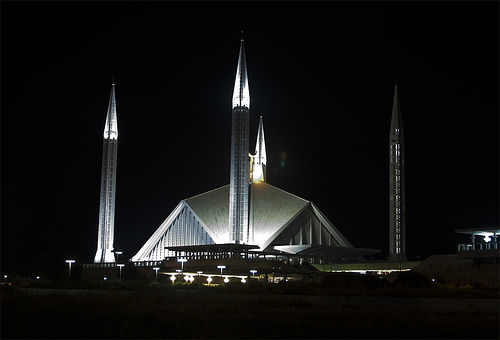
The mosque's architecture is a departure from the long history of South Asian Islamic architecture. It is one of the most outstanding and modern Islamic architecture examples in the world.
These Information is Taken by Wikipedia an some other.
Wednesday, September 23, 2009
Data Darbar Lahore
Data Durbar is the tomb of Hazrat Syed Abul Hassan Bin Usman Bin Ali Al-Hajweri, the famous Persian Sufi saint, where hundreds of thousands of people come each year to pay their respects and to say their prayers. It is located in Lahore, Punjab, Pakistan. The large complex also includes Jamia Hajveria, or Hajveri Mosque.
Minaret of Jamia Hajveria

View of Jamia Hajveria

View of the tomb

Closeup of the Mazar-e-Data

The Entrance to the mosque

Minaret of Jamia Hajveria

View of Jamia Hajveria

View of the tomb

Closeup of the Mazar-e-Data

The Entrance to the mosque

Wednesday, September 9, 2009
BHIT SHAH
Saint Hazrat Shah Abdul Latif Bhitai

Bhit Shah is a small town located in Matiari District, Sindh, Pakistan. It is most famous for being the location of the shrine of Sindh's greatest sufi poet, Shah Abdul Latif Bhittai.
Shrine of Abdul Latif Bhittai
The shrine is the centre piece of the town.
Museum
Located close to the shrine is very small museum which houses exhibits of stories mentioned in Shah Abdul Latif Bhittai's most famous work, Shah Jo Risalo. These include Sohni Mahiwal and Umar Marvi.
It is also a good tourist attraction in Pakistan.
Shah Abdul Latif,s Shrine
LOCATION: Near Hyderabad, Hala Sindh Pakistan
Friday, September 4, 2009
World,s Biggest Fort : Rani Kot
Rani Fort Valley View

Lake Camp Site

Rani Kot Fairy Pond

Rani Fort River

Rani Kot Fort West Wall

Rani Fort Sher Ghar Fortress

Rani Kot Fort East Wall

Rani Fort Wall

Rani Fort View

Ranikot Fort is the world's largest fort with a circumference of about 29 km or 18 miles. Since 1993, it has been on the list of tenative UNESCO World Heritage Sites.
World,s Biggest Fort

HISTORY:
Who constructed it first and why? Is an enigma yet to be resolved by researchers. Some archaeologists attribute it to Arabs,possibly built by a Persian noble under the Abbasids by Imran Bin Musa Barmaki who was the Governor of Sindh in 836 CE. Others have suggested a much earlier period of construction attributing to at times the Sassanians Persians and at times to the Greeks. Despite the fact that a prehistoric site of Amri is nearby, there is no trace of any old city inside the fort and the present structure has little evidence of prehistoric origins.
Archaeologists point to 17th century CE as its time of first construction but now Sindh archaeologists agree that some of the present structure was reconstructed by Mir Karam Ali Khan Talpur and his brother Mir Murad Ali in 1812 CE at a cost of 1.2 million rupees (Sind Gazetteer, 677).
Fort Ranikot is located in Lakki Mountains of the Kirthar range on the right side of the mighty River Indus at a distance of about 30 kilometers from the present day town of Sann. A mountainous ridge, Karo Takkar(Black Hill), running north to south, forms its western boundary and the 'Lundi Hills' forms its eastern boundary. Mohan Nai, a rain-stream enters the fort from its rarely used western 'Mohan Gate', where it is guarded by a small fortification, changes its name to 'Reni' or 'Rani Nai' or rain-stream and gives the fort its name. Ranikot is thus the 'fort of a rain stream' - Rani. It runs through it, tumbles in a series of turquoise pools to irrigate fields and leaves the fort from its most used 'Sann Gate' on the eastern side. It then travels about 33 kilometers more to enter the Lion River - Indus.
Most of the twenty kilometers long wall is made of natural cliffs and barricades of mountainous rocks which at places rise as high as two thousand feet above sea level! Only about 8.25 km portions of its wall are man-made, built with yellow sandstone. This was first measured on foot by Badar Abro along with local guide Sadiq Gabol. As one enters the fort, one can find hills, valleys, streams, ditches, ponds, pools, fossils, building structure, bastions, watchtowers, ammunition depots, fortresses - all inside Ranikot, adding more to its beauty and mystery. A spring emerging from an underground water source near the Mohan Gate is named as 'Parryen jo Tarr' (the spring of fairies).
According to a tale told by the local inhabitants, fairies come from far and wide on the Ponam Nights (full moon) to take bath at this spring near 'Karo Jabal'! Splashing sounds of water falling on the rocks can be heard at another spring, Waggun jo Tarr or "the Crocodile Spring", named so as crocodiles once lived there.
Within Ranikot, there are two more fortresses - Meeri and Shergarh, both have 5 bastions each. Meerikot takes its name from the word 'Mir' meaning top (for instance the top of a hill, chief of any Baloch tribe, etc.). Both the main Ranikot and the inner Meerikot have similar entrances - curved, angulated with a safe tortuous path. "The bridge in front of Ranikot resembles to a smaller bridge in front of a fortress in Verona, Italy" writes Ishtiaq Ansari, the writer of 'Sindh ja koat aaein qillaa' (Forts and Fortresses of Sindh) and a member of Sindh Exploration and Adventure Society. From the military point of view, Meerikot is located at a very safe and central place in the very heart of the Ranikot with residential arrangements including a water-well.
Talpur Mirs used Meerikot as their fortified residence. One can explore ruins of the court, harem, guest rooms, and soldiers quarters inside it. Its 1435 feet long wall has five bastions. Every structure in the Ranikot has its own uniqueness and beauty. Looking up from Meerikot one can find another fortified citadel - Shergarh (Abode of Lions) built with whitish stone, it too has five bastions. Though its location at 1480 feet above the sea level makes this fortress a unique structure, it also makes it equally difficult for supply of water, which can only be had from the brooks and rain streams, hundreds of feet below.The steep climb up to Shergarh gives a commanding view down over the whole fort and its entrance and exit points. On a clear day one can even see Indus, 37 kilometers away to the east.
Beside the Mohan Gate and the Sann Gate, there are two more gates, rather pseudo gates. One is towards the side of ancient town of Amri. This 'gate' is called the 'Amri Gate'. Certainly it takes its name from the prehistoric ruins of Amri, but it must have taken this name much later than the times of Amri as the fort itself doesn't appears to be as old as the Amri itself. In fact there is a bridge over rain stream 'Toming Dhoro' exiting from the fort called 'Budhi Mori'. The breach in fort wall due to the river stream has been referred as a gate. Similarly, the Shahpir Gate to the south also appears to be a pseudo gate taking its name from a limestone rock with a rough shape of foot imprinted on it. The sacred footprint supposedly belongs to Hazrat Ali or some other religious personality and is venerated by locals. It seems to be a later breach in the fort wall instead of a formal gate because one can't find any bastion or watchtower or their remains at the site, needed to guard any formal entrance or exit points.
A mosque found in the fort appears to be a later modification of a watchtower or a later construction. Scattered animal skeletons and prehistoric fossils can be found on the top of Lundi Hills. One of the three graveyards has about four hundred graves made of Chowkundi like sandstone with engraved motifs of sunflowers and peacocks. Whether we can call them as theriomorphic and phytomorphic motifs is an open question. Another one appears to be a graveyard of Arabs. The third one, about a mile away from the Sann Gate, had sixteen or seventeen graves earlier but now there are only four graves. The local inhabitants call it the Roman's graveyard.
LOCATION:
It is located in the Kirthar Range, about 30 km southwest of Sann, in Jamshoro District, Sindh, Pakistan. It is approximately 90 km north of Hyderabad.

Lake Camp Site

Rani Kot Fairy Pond

Rani Fort River

Rani Kot Fort West Wall

Rani Fort Sher Ghar Fortress

Rani Kot Fort East Wall

Rani Fort Wall
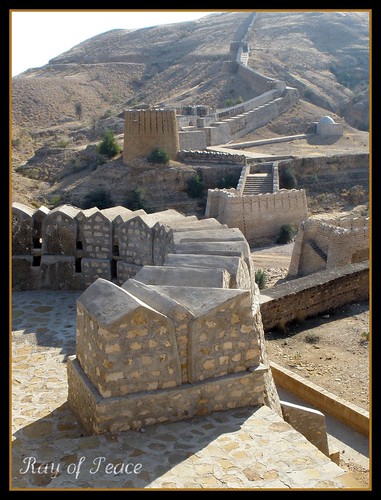
Rani Fort View

Ranikot Fort is the world's largest fort with a circumference of about 29 km or 18 miles. Since 1993, it has been on the list of tenative UNESCO World Heritage Sites.
World,s Biggest Fort

HISTORY:
Who constructed it first and why? Is an enigma yet to be resolved by researchers. Some archaeologists attribute it to Arabs,possibly built by a Persian noble under the Abbasids by Imran Bin Musa Barmaki who was the Governor of Sindh in 836 CE. Others have suggested a much earlier period of construction attributing to at times the Sassanians Persians and at times to the Greeks. Despite the fact that a prehistoric site of Amri is nearby, there is no trace of any old city inside the fort and the present structure has little evidence of prehistoric origins.
Archaeologists point to 17th century CE as its time of first construction but now Sindh archaeologists agree that some of the present structure was reconstructed by Mir Karam Ali Khan Talpur and his brother Mir Murad Ali in 1812 CE at a cost of 1.2 million rupees (Sind Gazetteer, 677).
Fort Ranikot is located in Lakki Mountains of the Kirthar range on the right side of the mighty River Indus at a distance of about 30 kilometers from the present day town of Sann. A mountainous ridge, Karo Takkar(Black Hill), running north to south, forms its western boundary and the 'Lundi Hills' forms its eastern boundary. Mohan Nai, a rain-stream enters the fort from its rarely used western 'Mohan Gate', where it is guarded by a small fortification, changes its name to 'Reni' or 'Rani Nai' or rain-stream and gives the fort its name. Ranikot is thus the 'fort of a rain stream' - Rani. It runs through it, tumbles in a series of turquoise pools to irrigate fields and leaves the fort from its most used 'Sann Gate' on the eastern side. It then travels about 33 kilometers more to enter the Lion River - Indus.
Most of the twenty kilometers long wall is made of natural cliffs and barricades of mountainous rocks which at places rise as high as two thousand feet above sea level! Only about 8.25 km portions of its wall are man-made, built with yellow sandstone. This was first measured on foot by Badar Abro along with local guide Sadiq Gabol. As one enters the fort, one can find hills, valleys, streams, ditches, ponds, pools, fossils, building structure, bastions, watchtowers, ammunition depots, fortresses - all inside Ranikot, adding more to its beauty and mystery. A spring emerging from an underground water source near the Mohan Gate is named as 'Parryen jo Tarr' (the spring of fairies).
According to a tale told by the local inhabitants, fairies come from far and wide on the Ponam Nights (full moon) to take bath at this spring near 'Karo Jabal'! Splashing sounds of water falling on the rocks can be heard at another spring, Waggun jo Tarr or "the Crocodile Spring", named so as crocodiles once lived there.
Within Ranikot, there are two more fortresses - Meeri and Shergarh, both have 5 bastions each. Meerikot takes its name from the word 'Mir' meaning top (for instance the top of a hill, chief of any Baloch tribe, etc.). Both the main Ranikot and the inner Meerikot have similar entrances - curved, angulated with a safe tortuous path. "The bridge in front of Ranikot resembles to a smaller bridge in front of a fortress in Verona, Italy" writes Ishtiaq Ansari, the writer of 'Sindh ja koat aaein qillaa' (Forts and Fortresses of Sindh) and a member of Sindh Exploration and Adventure Society. From the military point of view, Meerikot is located at a very safe and central place in the very heart of the Ranikot with residential arrangements including a water-well.
Talpur Mirs used Meerikot as their fortified residence. One can explore ruins of the court, harem, guest rooms, and soldiers quarters inside it. Its 1435 feet long wall has five bastions. Every structure in the Ranikot has its own uniqueness and beauty. Looking up from Meerikot one can find another fortified citadel - Shergarh (Abode of Lions) built with whitish stone, it too has five bastions. Though its location at 1480 feet above the sea level makes this fortress a unique structure, it also makes it equally difficult for supply of water, which can only be had from the brooks and rain streams, hundreds of feet below.The steep climb up to Shergarh gives a commanding view down over the whole fort and its entrance and exit points. On a clear day one can even see Indus, 37 kilometers away to the east.
Beside the Mohan Gate and the Sann Gate, there are two more gates, rather pseudo gates. One is towards the side of ancient town of Amri. This 'gate' is called the 'Amri Gate'. Certainly it takes its name from the prehistoric ruins of Amri, but it must have taken this name much later than the times of Amri as the fort itself doesn't appears to be as old as the Amri itself. In fact there is a bridge over rain stream 'Toming Dhoro' exiting from the fort called 'Budhi Mori'. The breach in fort wall due to the river stream has been referred as a gate. Similarly, the Shahpir Gate to the south also appears to be a pseudo gate taking its name from a limestone rock with a rough shape of foot imprinted on it. The sacred footprint supposedly belongs to Hazrat Ali or some other religious personality and is venerated by locals. It seems to be a later breach in the fort wall instead of a formal gate because one can't find any bastion or watchtower or their remains at the site, needed to guard any formal entrance or exit points.
A mosque found in the fort appears to be a later modification of a watchtower or a later construction. Scattered animal skeletons and prehistoric fossils can be found on the top of Lundi Hills. One of the three graveyards has about four hundred graves made of Chowkundi like sandstone with engraved motifs of sunflowers and peacocks. Whether we can call them as theriomorphic and phytomorphic motifs is an open question. Another one appears to be a graveyard of Arabs. The third one, about a mile away from the Sann Gate, had sixteen or seventeen graves earlier but now there are only four graves. The local inhabitants call it the Roman's graveyard.
LOCATION:
It is located in the Kirthar Range, about 30 km southwest of Sann, in Jamshoro District, Sindh, Pakistan. It is approximately 90 km north of Hyderabad.
Thursday, September 3, 2009
Hyderabad
Kotri Barrage

Latifabad no:7 fly over

THE 118 years old Tower, Model school

Rani Bagh

Mustafa park noorani basti

State life Building

Mcdonald,s

Sindh museum

The Heart of Hyderabad..... Hyder Chowk

Dargha Maki Shah Kacha Kila


Latifabad no:7 fly over
THE 118 years old Tower, Model school

Rani Bagh

Mustafa park noorani basti

State life Building

Mcdonald,s

Sindh museum

The Heart of Hyderabad..... Hyder Chowk

Dargha Maki Shah Kacha Kila

Wednesday, September 2, 2009
Moen-jo-Daro

Great bath room of Moen jo daro


Moenjo-daro was built around 2600 BCE and abandoned around 1900 BCE. It was rediscovered in 1922 by Rakhaldas Bandyopadhyay [1], an officer of the Archaeological Survey of India. He was led to the mound by a Buddhist monk, who believed it to be a stupa. In the 1930s, massive excavations were conducted under the leadership of John Marshall, K. N. Dikshit, Ernest Mackay, and others.[2] John Marshall's car, which was used by the site directors, is still in the Mohenjo-daro museum, showing their struggle and dedication to Mohenjo-daro. Further excavations were carried out in 1945 by Ahmad Hasan Dani and Mortimer Wheeler.
The last major excavation of Mohenjo-daro was conducted in 1964-65 by Dr. G. F. Dales. After this date, excavations were banned due to damage done to the exposed structures by weathering. Since 1965, the only projects allowed at the site have been salvage excavation, surface surveys and conservation projects. Despite the ban on major archaeological projects, in the 1980s, teams of German and Italian survey groups, led by Dr. Michael Jansen and Dr. Maurizio Tosi, combined techniques such as architectural documentation, surface surveys, surface scraping and probing, to determine further clues about the ancient civilization.
LOCATION: 14 Kilo Meter to Larkana, Sindh Pakistan
Tuesday, September 1, 2009
Makli Hill


Arghan,s tomb at makli

One of the largest necropolises in the world, with a diameter of approximately 8 kilometers, Makli Hill is supposed to be the burial place of some 125,000 Sufi saints. It is located on the outskirts of Thatta, the capital of lower Sind until the seventeenth century, in what is the southeastern province of present-day Pakistan. [1]
Legends abound about its inception, but it is generally believed that the cemetery grew around the shrine of the fourteenth-century Sufi, Hamad Jamali. The tombs and gravestones spread over the cemetery are material documents marking the social and political history of Sind.
Imperial mausoleums are divided into two major groups, those from the Samma (1352–1520) and Tarkhan (1556–1592) periods. The tomb of the Samma king, Jam Nizamuddin II (reigned 1461–1509), is an impressive square structure built of sandstone and decorated with floral and geometric medallions. Similar to this is the mausoleum of Isa Khan Tarkhan II (d. 1651), a two-story stone building with majestic cupolas and balconies. In contrast to the syncretic architecture of these two monuments, which integrate Hindu and Islamic motifs, are mausoleums that clearly show the Central Asian roots of the later dynasty. An example is the tomb of Jan Beg Tarkhan (d. 1600), a typical octagonal brick structure whose dome is covered in blue and turquoise glazed tiles. Today, Makli Hill is a United Nations World Heritage Site that is visited by both pilgrims and tourists.
Adress: Makli hill
near thatta , karachi,sindh,PaKISTAN
Minerat of Masoom Shah
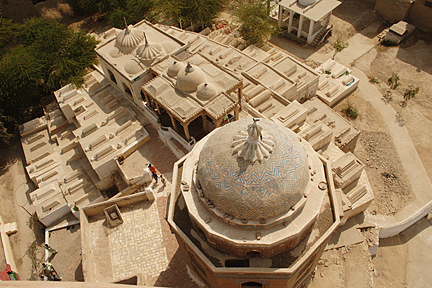

Uncountable stairs of Masoom shah Minerat

Hello,
The name is (Minerat of Masoom Shah)
The architecture of this tower is probably ungainly but there are few details that make it unique in Pakistan. The number 84 is significant with the architecture here as the tower is 84 ft (26 meters) high. One source claims the height of the minar as 31 meter. The number of steps to reach the top of the tower is 84. The circumference of the base of tower is also 84 feet.
The tower’s historical significance arises from the fact that it was built in 1605-1610 AD. In one of the references I read, the year of completion for the tower is given as 1607 A.D. Even with going with the conservative estimate of 1610 AD means the next year Tower of Masoom will complete 400 years of it existence.
It was built by Masoom Shah of Bukkur (an island on River Indus between Sukkur and Rohri). Masoom Shah was the Governer of the area in times of Mughal Emperor Akbar. The tower was built with the purpose of keeping a watch on the area.
On top of the tower is an observation balcony which is now covered with iron railing. At one time it became nototrious for suicidal people flinging themselves to death below. If you look carefully at the top of the tower in our title photo, you can see this iron railing on the viewing balcony. When was this iron cage built? I couldn’t research the date for sure but the last photo of this post below (circa 1896) shows this cage present, which means the iron cage was present atleast in the British era.
Next to the tower is a pavilion made of sandstone which has graves of Masoom Shah and his family. The sacrophagi are carved in the tradition of the Chaukundi tombs (near Thatta, Sindh). Photo to the left shows the view of these tombs from the top of the minar-e-Masoomi.
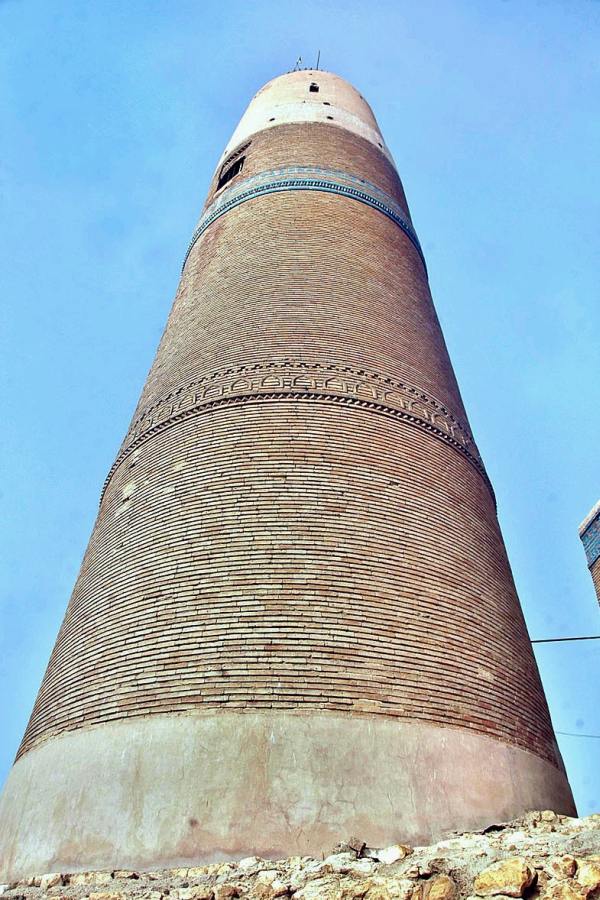
Cousens wrote in The Antiquities of Sind, "The most conspicuous feature in the landscape is the tall minar of Mir Ma’sum…Its dropsical proportions, and uncertain undulating outline suggest putty or dough as the material of its construction rather than brick and mortar. Its lantern top, surrounded with an iron cage, make it look more like an antiquated lighthouse perambulating through the country…It rises to a height of about a hundred feet, is eighty-four feet in circumference at the base, and is somewhat out of the perpendicular…Under the shadow of the minar rest the remains of Mir Muhammad Ma’sum Shah, his father, and other members of his family, the Ma’sumi Sayyids…Over the graves are open canopies supported on square, flat and octagonal stone pillars whose shafts are covered with Persian writing in relief and other ornamental tracery…Between Mir Ma’sum’s grave and the base of the minaret is a domed octagonal building, apparently intended as a rest-house, which was built in A.H. 1004 (Plate LXXVIII) [this image]. It has four arched entrances, those on the east and west having a cut-stone ornamental balconied window above each of them. It is built of brick and is decorated with coloured tiles.”
LOCATION: Sukkur City, Sindh Pakistan
Subscribe to:
Posts (Atom)


